Our Blog

Dental Emergencies in Children

February 23rd, 2022

Dental emergencies are bound to come up when you have young children. Dr. Wendy Tang and Dr. Amy Bellamy and our team want to you to be prepared in case you run into a difficult situation. Problems can vary, from minor gum irritation to knocked-out teeth. Take a look at the different possibilities and how you can handle them.

Teething

Depending on the age of your child, there are common things to watch for when it comes to his or her teeth. Starting from a young age, your son or daughter may experience teething pain. This starts at about four months and can last up to three years.

Teething may cause your little one to become irritable and more prone to drooling due to tender gums. This is very common in young children who are teething, and can be alleviated by giving them a cold teething ring or by rubbing their gums with your finger.

Teething pain is as normal as your child’s first set of teeth falling out. On the other hand, if a baby tooth is knocked out in a forceful accident, make sure you bring him or her into our Surrey, BC office to check that other damage hasn’t occurred in the mouth. On occasion, permanent teeth may grow in before baby teeth have fallen out. This may not cause any discomfort, but Dr. Wendy Tang and Dr. Amy Bellamy should make sure the teeth are growing in properly. Catching teeth that are coming in incorrectly can prevent issues from arising in adulthood.

Gum Issues

If you’ve noticed your child’s gums bleeding often, this could result from a number of things. Bleeding gums may be an early sign of periodontal disease, which is caused by poor oral hygiene when it appears in children. Excessive gum bleeding can also occur when children brush their teeth too hard, or suffer an injury to their gum tissue.

If bleeding is continuous, rinse your child’s mouth with warm salt water and apply light pressure to the area. If you become concerned about the amount of blood, contact our Surrey, BC office and we will schedule an appointment for your youngster as soon as possible.

Depending on what type of dental issue your child is experiencing, you should make sure to treat it quickly and properly. If you have questions or concerns about what you can do to help your son or daughter develop better oral hygiene habits, ask Dr. Wendy Tang and Dr. Amy Bellamy for tips during your next appointment.

Don’t forget: As a parent, you can provide the best education to your children on the importance of proper oral hygiene by setting a good example. 

What Are Chalky Teeth?

February 16th, 2022

You’ve always taken care of your child’s smile. You make sure thorough brushing and flossing take place twice a day. You serve foods high in vitamins and minerals and low in sugar. You make and keep regular dental appointments at our Surrey, BC office. But even with the best dental routines, sometimes conditions can occur that will require additional professional care.

One of these conditions can affect your child’s enamel while the tooth is still forming. When baby teeth or adult teeth appear, you might notice white, creamy yellow, or brown spots in otherwise healthy-looking enamel. These spots are softer and rougher than normal hard, smooth enamel. Because of their texture and color, such teeth are often referred to as “chalky teeth,” but this condition is actually known as enamel hypomineralization.

What is hypomineralization?

Enamel is the strongest substance in our bodies—stronger even than bones. Enamel is largely composed of minerals. If something disrupts the process of enamel development in baby or adult teeth, the result can be abnormally low mineral content in the enamel. This leaves teeth weaker and more likely to suffer decay and damage.

Premature birth, low birth weight, and other pre-natal factors have been suggested as risk factors for hypomineralization in primary teeth enamel. Permanent teeth can be vulnerable to this condition as well. Adult teeth are forming in young children well before they make an appearance. It’s been suggested that certain early childhood factors, such as recurring high fevers, some diseases, even specific antibiotics, can interrupt the formation of the enamel and lead to hypomineralization of adult teeth.

What are the results of enamel hypomineralization?

Children with this condition are much more likely to experience rapid tooth decay because of their weaker, more porous enamel, especially in the molars. Further, they tend not to respond as well to the numbing effects of local dental anesthetics, while their teeth tend to be more sensitive to pain. Cases can be mild, moderate, or severe. In severe cases, teeth might require crowns or possibly extractions, but even mild discoloration and other cosmetic problems can lead to self-consciousness in your child.

How can we help?

Catching this condition early is very important. If your child has had any medical conditions that might affect tooth development, let Dr. Wendy Tang and Dr. Amy Bellamy know even before that first tooth comes in. If you notice anything unusual about a new baby or adult tooth, give us a call. For primary or permanent teeth, the sooner we can begin treatment, the better the long-term outlook.

We might suggest fluoride applications or desensitizing treatments. We can apply sealants to reduce the risk of cavities, and use bonding to restore discolored or weak patches in the tooth. Both of these methods have greater success if the enamel near the affected area is in good condition, so early treatment is vital. If teeth require more protection, crowns are often the best choice. We will design a treatment program to suit your child’s individual needs now and for the future.

How can you help?

Dental hygiene is important for every child, but especially for a child with weak and porous enamel. Because children with hypomineralized enamel develop cavities more quickly that those with strong enamel, it is very important to watch your child’s diet and keep to a regular, careful, and thorough routine of brushing and flossing at home. Be attentive to any sensitivity problems, and be sure to follow any suggestions we might have for strengthening enamel.

Remember, early diagnosis and treatment is always best! If at any time you notice chalky patches, or have any other concerns about the appearance of your child’s teeth, if they seem to be causing your child pain or are unusually sensitive, call Dr. Wendy Tang and Dr. Amy Bellamy immediately. We want to work with you to treat any current problems and to prevent new ones.

Educational and Entertaining Enamel Experiments

February 9th, 2022

Let’s talk about the science of our teeth for a moment. Our enamel has a very high mineral content, making it extremely strong.  In fact, enamel just happens to be the hardest substance in our bodies.  But, unfortunately, it is not indestructible! Certain foods we eat can actually damage the surface of our teeth. Some simple and entertaining experiments can show children how our teeth can be affected by things we eat and drink, and how we can help protect them.

If you have a science-minded student at home, there are many activities you can do together, using educational websites, common household products and lots and lots of eggs. (Why eggs? Eggshells are a great substitute for teeth in these experiments. Not only are they various shades of white--like our own teeth, they are also calcium-rich—like our own teeth.) You can find any number of experiments using uncooked eggs, hardboiled eggs, whole shells with the contents blown out, or eggshells alone, so you can find just the right activity for whichever egg treatment works best for you.

Examine Enamel Erosion

One of the ways we protect our teeth is with healthy eating. The bacteria in plaque use the sugars and starches in our foods to produce acids. These acids are the substances that break down the minerals in our enamel and leave the enamel weaker. Weaker enamel is more easily attacked by bacteria and acids, which leads to cavities.

With eggs or eggshells and some carefully selected food products, you can see just how acidity affects teeth. Different websites suggest a variety of acidic liquids to dunk your eggs in, such as vinegar, soda, or citrus juices, so it’s easy to find an experiment that works with your pantry. Always use a plain water sample when you submerge eggs or shells to act as a control to measure differences against. How do the egg shells soaked in acidic liquids differ from those in plain water? It’s also fun to add simple sugar water as a test liquid to see what happens. Is it sugar or acid that causes more damage? And why might that be?

The Fluoride Fix

Fluoride is well known as a mineral that protects the structure of our teeth and helps prevent cavities. And there are actually experiments out there to test the protection fluoride provides using your egg stand-ins.

In some experiments, a hardboiled egg is coated with fluoride toothpaste or rinse for a specific amount of time and then dunked into vinegar. An untreated egg also gets a vinegar bath. You are asked to observe what is happening to each egg as it sits in its vinegar bath—are there bubbles on one egg and not the other? What do the bubbles mean? Other experiments require longer exposure to fluoride and then to vinegar—what happens to the shells of the treated and untreated eggs? What could this mean for our teeth?

Staining Studies

Our diet can do more than help create cavities. Enamel is very strong, but it is not stain-proof! Dark colored foods and drinks can make our teeth appear darker or more yellow. (And teeth that have suffered enamel erosion can pick up stains more easily.) How does food affect the brightness of our smiles?

If this question interests you, find experiments that use favorite beverages as a soak for your eggs. Choose liquids with a range of color, such as coffee, soda, and apple juice. Or choose an experiment that uses different varieties of soft drinks. Will foods the same color cause the same amount of discoloration in your egg volunteers? Do you want shorter or longer soaks in each liquid? Do you want to make use of a recycled toothbrush to see if brushing that discolored shell makes a difference? With toothpaste or without?

Even though these activities are designed for older children, they still require adult supervision. You can find detailed instructions for any of these experiments at many science and educational sites online. With some household supplies, plenty of extra cups, and a quantity of eggs, you and your child can demonstrate some of the basic effects our food choices have on the health and appearance of our teeth. It’s a wonderful way to promote healthy eating and brushing habits, scientific curiosity, and shared experiences!

Don’t forget to let Dr. Wendy Tang and Dr. Amy Bellamy know how your experiments turned out the next time you visit our Surrey, BC office!

Brushing Your Toddler’s Teeth

February 2nd, 2022

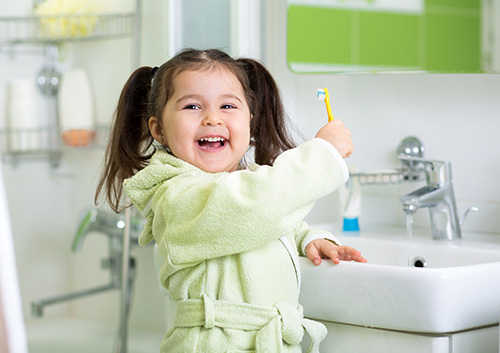
At Just 4 Kids Pediatric Dentistry, we know that brushing your toddler’s teeth can be an intimidating prospect. So we’re providing a few tips in the hope of making the process a lot more easy, effective, and all-around enjoyable for everyone!

Start by getting into a position that gives you control and enables you to see well into your child’s mouth. If you can see clearly, you will be able to maneuver the toothbrush better around your son or daughter’s mouth for a better quality of brushing.

It’s important to choose a time when your toddler is calm. Have your little one sit with his or her favorite stuffed animal, or play a fun movie in the background so your child can focus on something comforting while you’re brushing.

Using a circular motion, brush all sides of their teeth. Be sure to let your toddler have a turn after you’re done, to start getting used to it. This way, he or she is more likely to repeat the brushing and flossing exercise when your youngster is old enough.

Dr. Wendy Tang and Dr. Amy Bellamy and our team agree that brushing and flossing need to be performed with kindness and care. To ensure your child learns good dental hygiene habits early on, be gentle and make this time a happy, learning time.

Your child should also have regular appointments at our Surrey, BC office for checkups and cleanings to keep on track!

Mon 8:00am to 4:00pm Tue 8:00am to 4:00pm Wed 8:00am to 4:00pm Thu 7:30am to 5:00pm Fri 8:00am to 4:00pm