Our Blog

Dental Emergencies while Traveling

April 27th, 2022

You’ve planned your dream vacation. Your reservations are made. You’re packed and ready. You’ve even scheduled a dental checkup at our Surrey, BC office to make sure you catch any potential problems, have finished any major work, and have an up-to-date chart.

But things don’t always go according to even the best of plans. So, what to do if you find you have a dental emergency while traveling? Dr. Wendy Tang and Dr. Amy Bellamy and our team have some recommendations for problems that might arise.

  • Toothache—Rinse your mouth with warm water and use dental floss to remove any food particles. Never put aspirin directly on a tooth or gum tissue. If the pain persists, call a dentist.
  • Cracked or broken tooth—Immediately rinse with warm water to clean the area and apply cold compresses to the face to minimize swelling. Get in touch with a dentist.
  • If you lose a tooth—Keep the tooth moist at all times. Put the tooth back in the socket without touching the root if possible. If that is not an option, place the tooth between the cheek and gums or in milk. See a dentist as soon as possible.

Know where to get help if you need it! If you are traveling in the United States, the American Dental Association offers Find-a-Dentist, a website that can locate a member dentist closest to you. If you are traveling to another country, there are steps you can take to prepare for an emergency.

  • If you are out of the country and need to locate a dentist, your local embassy or consulate, your hotel concierge, or friends abroad can be a useful resource.
  • Before you go, check your insurance to see if you are covered while traveling.
  • If you have travel insurance, find out if it covers dental treatment and can provide information on qualified local dentists and translation help, if necessary.
  • Good dental care is available in many areas internationally, but it is important to know what standards are present in the countries you plan to visit. The Organization for Safety and Asepsis Procedures offers a checklist for safe treatment in their “Traveler’s Guide to Safe Dental Care.”

If you have any questions, Dr. Wendy Tang and Dr. Amy Bellamy and our team are happy to do all we can to answer them. While it’s unlikely that problems will arise, we are always available if you need to contact our Surrey, BC office. Bon voyage, and we look forward to hearing about your trip!

Every Day is Earth Day

April 20th, 2022

During the early days of the environmental awareness movement, those who demonstrated against pollution, toxic chemicals, and the general public health were known as hippies. The early 1970s were a time of change, and assertions that we needed to pay more attention to the Earth's atmosphere were generally dismissed. But within a couple decades, it had become clear that the previous generation was right; the citizens of the world needed to become more environmentally conscious.

Many people feel that they can't make a difference if they don't do something big. But caring for the environment doesn't have to be an all-or-nothing concept. In fact, the little things you do can add up to make a great impact, especially in our community. Here are a few ways you can help the environment on Earth Day, April 22nd and all year around.

Four Small Ways to be Environmentally Friendly

  • Recycle Your Textiles. Nearly 21 million tons of textiles are added to American landfills each year, according to the Environmental Protection Agency. Donating your unwanted clothing to a secondhand store or an organization that repurposes fabric helps cut down on solid waste and conserves natural resources.
  • Reduce Usage of Disposables. Plastic bottles and bags, disposable diapers and other things we can use and toss out are convenient, but they're not necessary. Simply choosing to replace one of type of disposable with a reusable product can help you cut down on waste that has a large negative impact on our environment.
  • Conserve Water. If everyone in the United States turned off the water while brushing their teeth, more than 1.5 million gallons of water could be conserved. Turn the water on long enough to wet your toothbrush for brushing and rinsing, and then immediately turn the water off again.
  • Turn Off the Lights. Flip the light switch to "Off" if you're going to leave a particular room for 15 minutes or more. This will conserve energy on incandescent light bulbs and cut down on cooling costs.

It's not necessary to be an activist or install solar panels all over your home to help the environment. Although you can do these things, the little everyday measures make a big difference in helping to conserve energy and the environment, while reducing your carbon footprint. Our team at Just 4 Kids Pediatric Dentistry wants to remind you to celebrate Earth Day and help the environment, knowing that it will benefit your and your children's generation.

Thumb Sucking

April 13th, 2022

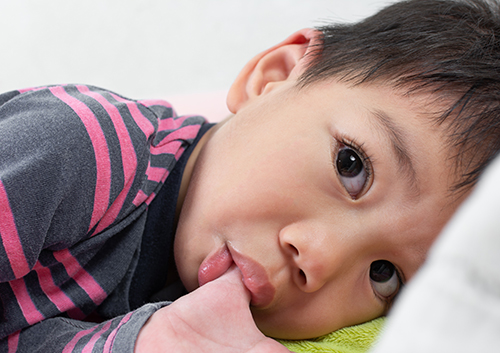
Learning to suck their thumbs is one of the first physical skills babies acquire. In fact, ultrasound images have revealed babies sucking their thumbs in the womb! Babies have a natural sucking reflex, and this activity is a normal way for your baby to soothe herself.

If your toddler still turns to her thumb for comfort, no need to worry. Most children give up this habit as they grow, and generally stop completely between the ages of two and four. But what of the child who doesn’t? Should you encourage your child to stop? And when?

When Thumb Sucking Becomes a Problem

After your child turns five, and certainly when her permanent teeth start to arrive, aggressive thumb sucking is something to watch for. This type of vigorous sucking, which puts pressure on the teeth and gums, can lead to a number of problems.

  • Open Bite

Our bites are considered normal when the upper teeth slightly overlap the lower where they touch in the front of the mouth. But with aggressive thumb sucking, teeth are pushed out of alignment. Sometimes this results in a condition called “open bite,” where the upper and lower teeth don’t make contact at all. An open bite almost always requires orthodontic treatment.

  • Jaw Problems

Your child’s palate and jaw are still growing. Aggressive thumb sucking can actually change the shape of the palate and jaw, and even affect facial structure. Again, orthodontic treatment can help, but prevention is always the better option!

  • Speech Difficulties

Prolonged thumb sucking has been suggested as a risk factor for speech disorders such as lisping, the inability to pronounce certain letters, or tongue thrusting.

The consequences from aggressive thumb sucking can be prevented with early intervention. What to do if you are worried?

Talk to Us

First, let us reassure you that most children stop thumb sucking on their own, and with no negative dental effects at all. But if your child is still aggressively sucking her thumb once her permanent teeth have started erupting, or if we see changes in her baby teeth, let’s talk about solutions during an appointment at our Surrey, BC office. We can offer suggestions to help your child break the habit at home. There are also dental appliances available that can discourage thumb sucking if your child finds it especially hard to stop.

Work with your Child

  • Be Positive

Positive reinforcement is always best. Praise her when she remembers not to suck her thumb. Make a chart with stickers to reward every thumb-free day. Pick out a favorite book to read or activity you can share.

  • Identify Triggers

Children associate thumb sucking with comfort and security.  If your child turns to her thumb when she’s anxious, try to discover what is bothering her and how to reassure her. If she automatically sucks her thumb when she is bored, find an activity that will engage her. If she’s hungry, offer a healthy snack.

  • Talk about It!

Depending on her age, it might help your child to understand why stopping this habit is important. We are happy to explain, in a positive, age-appropriate way, just how breaking the thumb sucking habit will help her teeth and her smile.

Again, most children leave thumb sucking behind naturally and easily. But if what is a comfort for your child has become a concern for you, please give us a call. Dr. Wendy Tang and Dr. Amy Bellamy will work with you and your child to prevent future orthodontic problems and begin her lifetime of beautiful smiles.


Is a Crown Necessary for My Child’s Baby Tooth?

April 6th, 2022

Part of the charm of your child’s smile is those delicate, diminutive baby teeth. We enjoy those smiles while we can, because soon enough, primary teeth make way for the adult teeth that will last your child a lifetime. So you might be surprised if Dr. Wendy Tang and Dr. Amy Bellamy and our team recommend a crown for your child’s baby tooth. Is this procedure necessary when the tooth is going to fall out eventually anyway?

Yes, it really is. If a primary tooth is lost before its normal lifespan, several problems can arise.

  • Biting and chewing—a full set of baby teeth is best for proper chewing and digestion. And chewing also helps develop face and jaw muscles.
  • Speech development—primary teeth help guide speech production and pronunciation.
  • Spacing—a baby tooth serves as a place holder for the adult tooth waiting to replace it. If a primary tooth is lost too early, teeth may drift from their correct location and cause overcrowding or misalignment.

When is a Crown Necessary?

The enamel in a baby tooth is thinner than the enamel found in adult teeth, and a cavity can spread quickly throughout a tooth. Within a short period, the tooth’s structure might be too weak for a regular filling. Sometimes the pulp inside the tooth becomes injured or infected and an endodontic treatment is necessary to remove pulp tissue from inside the tooth. The interior will be filled, but the delicate enamel surrounding it will be fragile. Or an accident can leave a tooth fractured or broken, but still vital.

In each of these cases, a crown will protect the tooth from further decay or damage, and will allow the tooth to function normally until an adult tooth is ready to replace it.

What Types of Crowns are Available?

By far the most common choice for a primary tooth is a stainless steel crown. These crowns are prefabricated and can be fitted snugly to your child’s individual tooth. They are easy to place, less expensive than other crown alternatives, and will last until the tooth is ready to fall out in its proper time. If your child suffers from a metal allergy, or a more natural looking crown is necessary, talk to us about other possible options during your appointment at our Surrey, BC office.

Sure, preserving a baby tooth that was never designed to be permanent seems contradictory. But saving a tooth that helps your child develop proper eating habits, speech production, and correct adult tooth alignment? Those are benefits that will last a lifetime.

Mon 8:00am to 4:00pm Tue 8:00am to 4:00pm Wed 8:00am to 4:00pm Thu 7:30am to 5:00pm Fri 8:00am to 4:00pm